
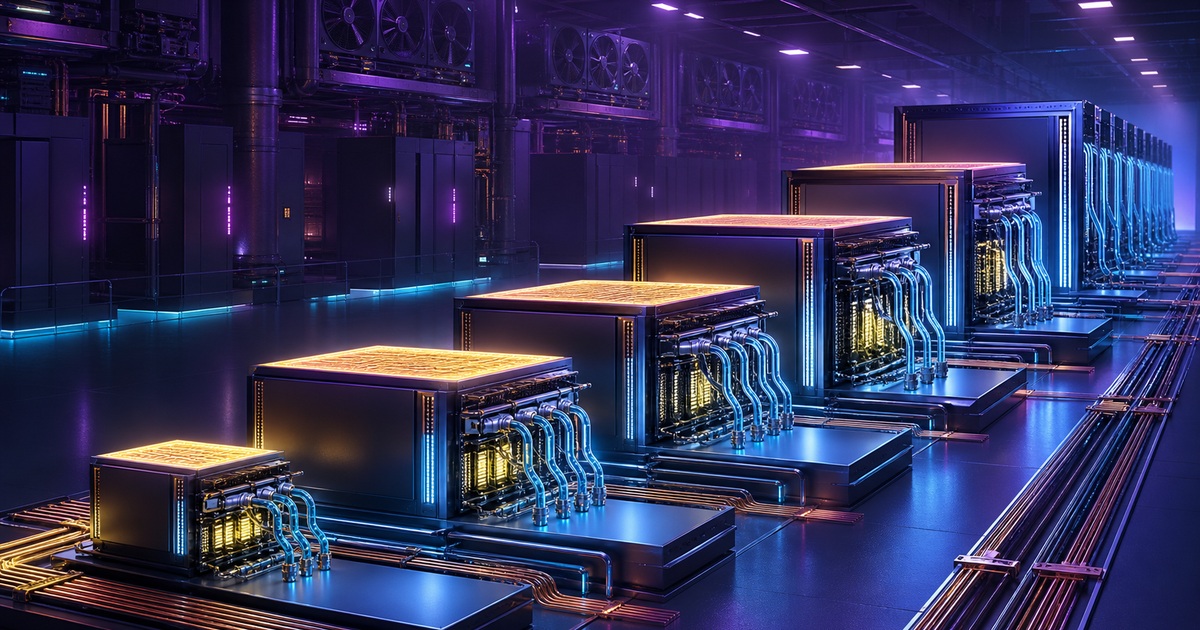
An AI roadmap needs enough power and cooling for the workload expected at each product stage, plus a measured reserve for failure and growth. The estimate starts with the servers and accelerators that will actually run, converts their demand into facility load and heat rejection, and checks whether the site can deliver that capacity continuously. A model roadmap without this physical plan can promise growth that the building cannot support.
The useful output is not one permanent number. It is a staged capacity envelope for pilot, launch, expected growth, and stress demand, with assumptions, owners, measurement dates, and a clear trigger for the next infrastructure decision.
Translate product stages into an IT load envelope
List the workloads introduced at each roadmap stage. Separate interactive inference, batch jobs, training, retrieval, storage, observability, and non-AI application services. For each one, record the planned hardware configuration, expected concurrency, runtime pattern, memory requirement, network demand, and recovery mode. Keep baseline demand separate from short peaks.
Use three kinds of evidence. Vendor specifications define the maximum equipment requirement and installation boundary. A representative benchmark shows the draw and heat produced by the selected workload. Production telemetry shows how demand changes over time. Do not substitute one for another. A nameplate maximum is useful for electrical safety, while an average benchmark alone may hide a critical peak.
The physical AI infrastructure bottleneck explains why power, cooling, land, and access can constrain growth. This article turns that constraint into a roadmap calculation rather than another market forecast.
Create a low, expected, and high load for every stage. Include accelerator servers, CPUs, storage, network equipment, and management systems. Add the load required during maintenance or component failure. If the recovery design starts extra capacity during an incident, that capacity belongs in the plan.
Convert IT demand into facility and cooling capacity
Almost all electrical energy consumed by the IT equipment becomes heat that the facility must remove. Cooling capacity therefore follows measured and maximum IT load, but the electrical feed must also support cooling equipment, pumps, fans, power conversion, lighting, and other overhead. Use facility measurements or engineering specifications instead of a generic multiplier.
Map the complete path from utility or generator to the rack. Check switchgear, transformers, uninterruptible power, distribution units, breakers, cabling, rack feeds, and connectors. The weakest component sets the usable limit. Redundant feeds help only if both paths have sufficient independent capacity and a real failure does not overload the remaining path.
Cooling needs the same path analysis. Record the heat source, air or liquid loop, heat exchanger, pumps, chillers or dry coolers, controls, water requirements, and external heat rejection. High-density accelerators may require a different cooling technology or rack arrangement. The change can affect floor loading, maintenance access, delivery time, and the amount of equipment that fits in the room.
Capacity assumptions can change when models, accelerators, or access patterns jump. Use the AI capability-jump adaptation framework to define which facility commitments remain useful under a different technical path. Power and cooling are not only engineering constraints; they are commitments that need explicit change triggers.
Stage the roadmap around measured capacity gates
Approve each growth step only when a capacity gate has evidence. The gate should confirm representative workload performance, available electrical headroom, available cooling headroom, network capacity, alarm coverage, failure behavior, maintenance access, and an owner for operations. Record which measurement would force the next review.
For an early pilot, rented capacity can keep facility work outside the critical path. A later steady workload may justify local or colocated equipment, but only after the economics of running AI locally include the physical and operational boundary. Buying accelerators before power and cooling are ready simply converts a capacity risk into idle capital.
Run a load test and a controlled failure test at every major stage. Observe electrical draw, inlet and component temperature, throttling, queue growth, latency, and recovery. Keep the same acceptance criteria used for the product. A facility that stays within temperature limits while the user experience fails is not sufficient.
For this power-and-cooling roadmap, our team’s relevant experience comes from delivering and supporting high-load media-platform infrastructure at roughly one million daily users. That delivered-project scale supports one practical point: capacity, observability, redundancy, and recovery must be planned together. It does not establish a universal rack density, uptime target, or savings claim.
Frequently Asked Questions
Map each roadmap stage to a representative hardware configuration and workload, measure expected and peak draw, then include supporting IT equipment, redundancy, facility overhead, and expansion headroom.
Electrical energy used by IT equipment becomes heat that must be removed continuously. A rack can have available electrical power and still be unusable if airflow, liquid loops, or heat rejection cannot support it.
Use both for different decisions. Nameplate values define installation and safety boundaries, while workload measurements inform expected operation. Stress and failure cases reveal peaks that averages can hide.
It should verify workload performance, power and cooling headroom, network capacity, monitoring, failure behavior, maintenance access, operational ownership, and the measurement that triggers the next review.
If your roadmap needs an independent capacity envelope before procurement or colocation approval, explore AI4SALE IT support and DevOps services. The review should connect each roadmap stage to measured workload demand, facility headroom, failure assumptions, and a dated expansion trigger.
Before committing equipment or facility capacity, AI4SALE can verify power and cooling readiness for the next AI stage.