
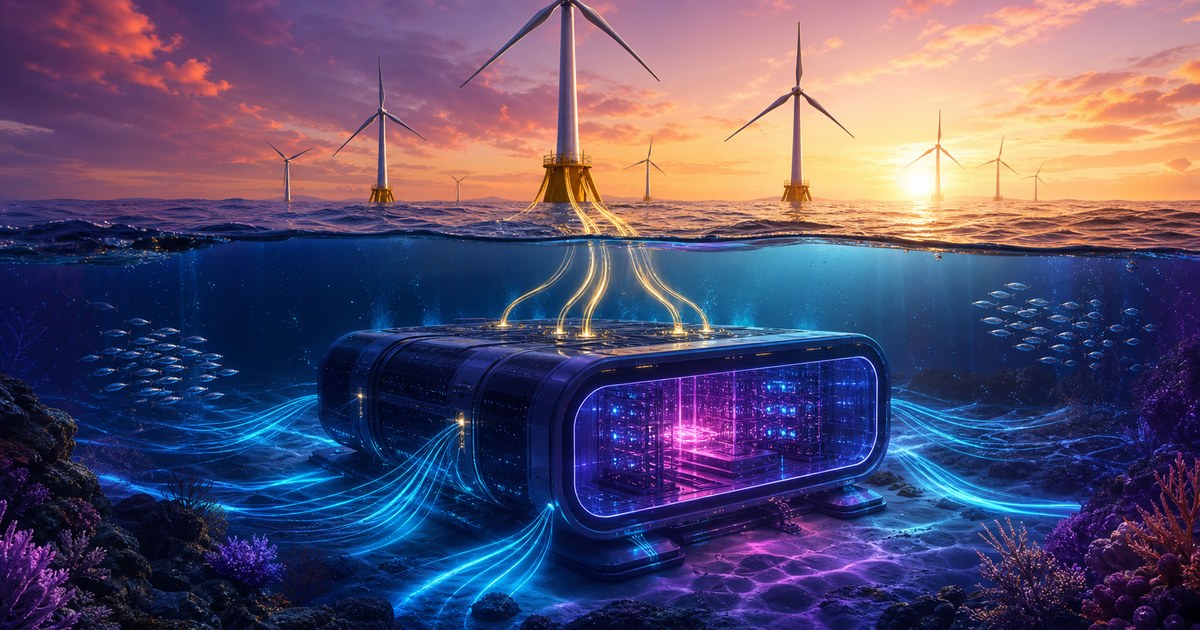
The next AI infrastructure bottleneck is physical: access to power, heat removal, land, grid capacity, and reliable operations will decide whether serious AI systems can scale with healthy margins. The Shanghai Lingang underwater data center makes that constraint visible. Its operational first phase is 2.3 MW, while 24 MW and $226 million describe the total two-phase project, which is planned around approximately 2,000 servers.
Official project reporting supports these parameters. The Lin-gang Special Area project overview confirms 24 MW as total capacity and describes direct offshore wind power with seawater cooling. China’s Ministry of Transport confirms the two-phase plan and the 2.3 MW operational first phase.
This is bigger than an unusual location. It shows that the economics of AI are moving below the software layer, into the systems that feed, cool, house, and maintain compute.
Shanghai turned an AI constraint into a physical design
The Lingang installation has entered commercial operation using direct offshore wind power and seawater cooling. The important choice is not simply putting servers offshore. It is placing compute near an energy source and redesigning the cooling path around the site.
That removes some familiar data center assumptions. A conventional project may need a large land parcel, grid upgrades, long power transmission paths, and chiller-heavy cooling. An offshore module changes that equation, but it does not make infrastructure free or simple. It trades familiar constraints for different ones.
- Power: GPU clusters need dependable capacity, not an attractive energy headline.
- Cooling: heat must leave the equipment continuously and predictably.
- Placement: land, permits, cables, network routes, and access shape the real schedule.
- Maintenance: sealed modules and offshore conditions make replacement planning more demanding.
The 2.3 MW first phase matters because operational capacity is different from announced project capacity. The complete two-phase plan may reach 24 MW, but founders should model the capacity available now, the expansion path, and the dependencies between them. That discipline prevents a large project number from becoming a false assumption in a business case.
AI margin starts with watts, heat, and utilization
Model selection still matters. So do token prices and engineering quality. But once workloads become persistent, margin also depends on the physical cost of delivering every useful unit of compute. Electricity enters the facility. Servers convert much of it into heat. Cooling, power distribution, networking, redundancy, and idle capacity add cost before an application produces revenue.
To turn those layers into a comparable budget, use our production AI infrastructure total cost framework before choosing capacity.
This is a different decision from comparing cloud and dedicated hardware costs. That comparison asks where capacity should run. The infrastructure bottleneck asks whether enough power, cooling, space, and operational coverage exist for that capacity at all.
It is also distinct from the founder economics of running AI locally. A local model can reduce dependency on per-request pricing, but ownership moves more responsibility onto the operator. Hardware must be powered, cooled, secured, monitored, patched, and replaced. Low API spend does not guarantee low total cost.
Founders should treat utilization as a bridge between software and infrastructure. Expensive hardware sitting idle destroys the expected advantage. Hardware running near its limit without thermal or maintenance headroom creates reliability risk. The useful target is not maximum utilization at every moment. It is enough productive utilization to support the business case while preserving safe operating margins.
Physical efficiency introduces operational risk
Underwater infrastructure can reduce pressure on land and conventional cooling, but the operating risks are concrete. Saltwater is corrosive. Sealed modules restrict immediate access. Subsea cables become critical paths. A failed component may take longer or cost more to reach. These are design inputs, not footnotes.
The same logic applies to less dramatic AI deployments. A rack in an office, a colocated GPU cluster, and a regional data center all need clear answers to the same questions:
- Which power or network failure can stop the workload?
- How much thermal headroom remains during peak demand?
- Who can replace failed hardware, and how quickly?
- Which spare parts and recovery procedures exist before an incident?
- What happens to customer operations while capacity is unavailable?
Redundancy also needs economic context. Duplicating every component can make a system unaffordable. Duplicating nothing can make one failed cable or cooling unit a revenue event. The right design starts with the workload’s business impact, recovery requirement, and acceptable degradation. Infrastructure should follow those constraints.
Founders need an infrastructure thesis before scale
A serious AI plan needs more than a preferred model and a monthly software budget. It needs an infrastructure thesis: where the workload runs, how capacity grows, which physical constraint arrives first, who operates the stack, and how failure affects customers.
For enterprise AI delivery and integration, this means connecting the use case to a capacity and operations plan before promising scale. Start with workload shape. Separate steady demand from bursts. Estimate power and cooling needs for owned capacity. Map the network and grid dependencies. Assign maintenance and incident ownership. Then compare the complete operating cost with the value the system is expected to create.
The Shanghai project is useful because it exposes the layer many AI plans hide. Better prompts can improve an application. They cannot create grid capacity, remove heat, shorten a repair trip, or protect margin from poor utilization. The model is one layer. The durable advantage comes from designing the system underneath it.
Frequently Asked Questions
It is a physical or operational limit that prevents an AI workload from scaling reliably or economically. Common limits include available power, cooling capacity, land, grid connections, network paths, maintenance access, and recovery capability.
No. The operational first phase is 2.3 MW. The 24 MW figure and the reported $226 million investment refer to the total two-phase project, which is associated with approximately 2,000 servers.
An offshore design can locate compute near wind generation and use seawater cooling while reducing pressure on land and conventional chiller systems. It also introduces corrosion, cable, sealed-module, and maintenance-access risks.
Compute costs include more than models and chips. Electricity, cooling, power distribution, networking, redundancy, idle capacity, maintenance, and downtime all affect the cost of delivering a useful AI workload.
Define the workload shape, available capacity, power and cooling headroom, growth path, failure modes, recovery requirements, operating owner, and total cost. Compare those constraints with the business value and acceptable service risk.
Before committing to another AI workload, use our Free website / AI readiness audit to identify which infrastructure constraints could hit margin first.
For a provider-led capacity decision, AI4SALE can resolve the first physical constraint before capacity commitment.